For most of the last four decades, the empty lot on the west side of A1A near the south end of Highland Beach has been treated like a yes-or-no question. Would the county finally build a park there, or wouldn't it? That framing was always too simple. Over time, the debate shifted from whether Highland Beach would get a park to the size and scope of the planned park.
If you have lived on this stretch of the peninsula for any length of time, you already know the outline. The debate has also centered on a single number: the proposed parking capacity, which has declined over more than fifteen years.
The Land Was Almost 130 Condos, Not a Park
The parcel's history starts with development, not preservation. Cam D. Milani bought just over five acres on Highland Beach's west side intending to build 130 multi-family units. The Town Commission at the time fought the plan, and years of litigation followed. The dispute eventually settled into an agreement that would have allowed Milani to build 65 units instead, a plan that never got built. When that deal fell apart and another developer's interest fell through, Milani's widow, Lucia, sold the property to Palm Beach County in 1987 for $3.9 million, on the condition that it become a public park named for her late husband.
That history provides context for what followed. The park plan was a different use of the land from the earlier proposal for 130 multi-family units.
How Parking Plans Changed Over Time
Once the county owned the land, the fight moved from whether to how much parking a beach park should be allowed. That number is useful to track because it shows how the proposed parking capacity changed over time.
| Point in time | Parking spaces on the table |
|---|---|
| 2010 stipulated settlement agreement | 120 |
| County's earlier phase proposal, before the most recent compromise | 100 |
| Compromise reported in early 2026 coverage | 46 |
| Phase I, per the Town's own 2025-2026 Strategic Priorities Plan | 38 |
The 2010 agreement, negotiated to end litigation between the town and the county over the park's special exception approval, locked in 43 separate conditions covering everything from lifeguard staffing to bathroom facilities. It did not lock in a small park. It described one built around 120 parking spaces on a 5.6-acre site straddling A1A. Later plans list fewer parking spaces than the 2010 agreement, making parking capacity one of the features that changed over time. The two most recent figures, 46 and 38, do not fully agree, which is itself telling. Even the county and the town are not describing Phase I with the exact same number, but both landed far below where the fight started.
That matters if you live near the site, because parking count is the single best predictor of how much daily traffic, weekend crowding, and beach access pressure the finished park will actually generate. A lot capped in the high thirties or forties behaves nothing like a 120-space lot, even on the same acreage.
What Actually Gets Built on the 5.6 Acres
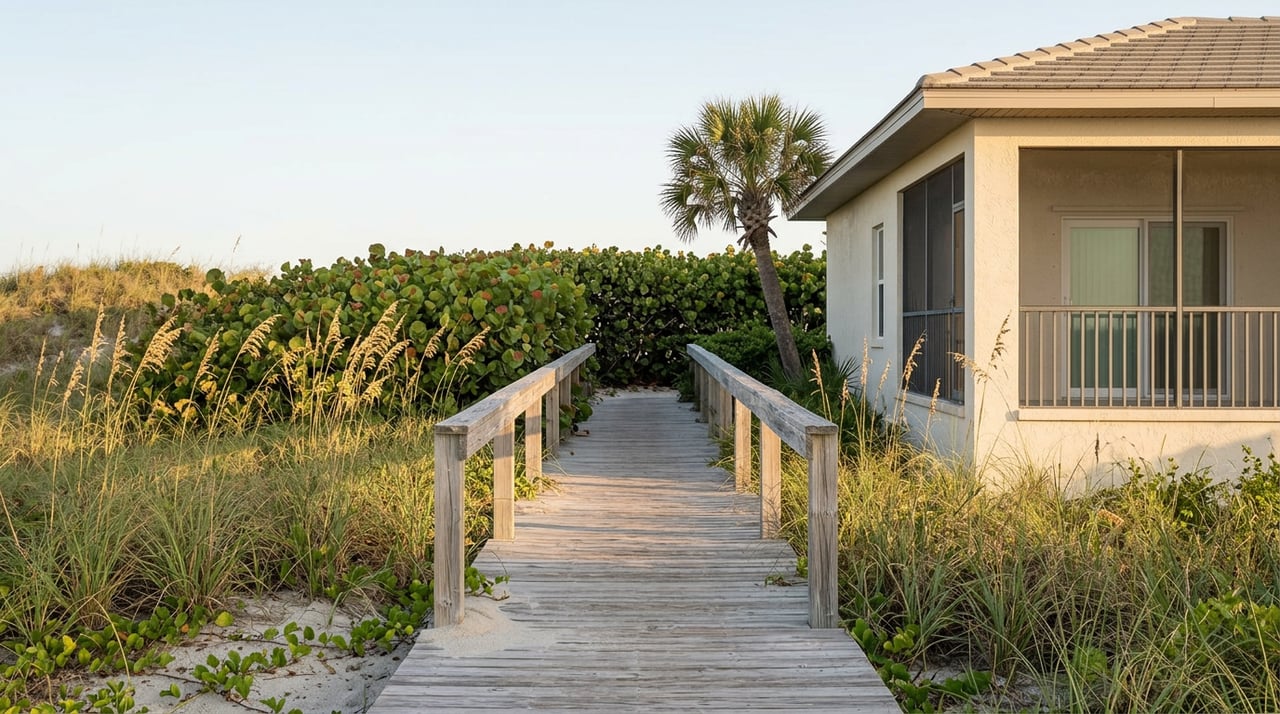
Set the parking argument aside and the physical plan is fairly modest. County procurement records describe a guardhouse with an access-controlled gate at the parking lot entrance, an elevated boardwalk connecting the inland parcel to the beachside parcel across A1A, a combined restroom and lifeguard building, and landscaping. Architecture firm Brooks + Scarpa was selected in mid-2024 to handle design and permitting.
Palm Beach County filed permit applications and a compliance package with the Town of Highland Beach in April 2026, the step that has to clear before construction can start. County Parks and Recreation Director Jennifer Cirillo has estimated the construction phase at roughly 18 months once permits are approved, which would put completion somewhere around fall 2027 if work begins this year as the town's own capital plan anticipates. The applications also cover new water and sewer connections to the parcel, work that has to happen before any of the rest of it can proceed.
None of that reads like a landmark. It reads like a small, gated, heavily conditioned beach access point, which is exactly what 40 years of legal back-and-forth produced.
The Rock Nobody Could Legally Reach
The one part of this story that has nothing to do with parking counts is Yamato Rock, a coral outcropping within the park boundary that has drawn snorkelers for generations. The name comes from the Yamato Colony, a community of Japanese immigrant farmers who settled in what is now Boca Raton and Delray Beach in the early 1900s. County records treat the site as archaeologically significant, tied to a settlement history that predates almost everything else on this stretch of coastline.
Here is the part that current residents may not have connected yet. Highland Beach has no public beach access point today. Every inch of shoreline in town runs behind private residential parcels and condominium associations. That means Yamato Rock, sitting inside county-owned land the whole time, has effectively been unreachable to the public despite decades of a park supposedly being built around it. The boardwalk in the current design is what finally changes that, connecting a public parking area to a public path to a specific, named natural feature that has been sitting behind private access for as long as most residents have lived here.
The Argument Has Never Been One-Sided
The split in local opinion has stayed remarkably consistent from one commission meeting to the next. Highland Beach resident Ron Reame told CBS12 that the land's value made continued vacancy hard to justify, framing the alternative bluntly: a park or a high-rise. Neighbor Janet Lugers made the opposite case for the same underlying worry, saying she would rather see a park than another development on that lot. Both were responding to the same fact: this land was never going to sit empty forever, and the only real choice was which use would replace the empty lot that has stood there since the 1987 sale.
Residents near the site also raised concerns about traffic and parking spillover onto residential streets, adding another dimension to the debate over the park’s design.
Where This Leaves the Three Miles In Between
If the current timeline holds, Highland Beach will get its first legal public beach access point sometime around 2027, gated, capped at a fraction of the parking originally guaranteed, and built around a boardwalk that finally connects the road to a rock most residents have heard of but never walked to. That is a much narrower outcome than either side's original position implied. It is also, given the last four decades, the version that was always most likely to actually get built.
The lesson for anyone who has lived through even part of this fight is that the yes-or-no framing obscured the real decision points the whole time. The debate has centered on the number of parking spaces in the plan and the extent of public shoreline access.
If you want to talk through what any of this means for a specific address on this stretch of A1A, or you are weighing a move to Highland Beach and want the unfiltered read on what is actually changing here versus what has just been rumored for years, Roxy Campbell has been working Palm Beach County long enough to separate the two. Call or text Roxy at (561) 714-9673.